
How Long Do Kitchen Faucets Last? Lifespan, Maintenance and Replacement Tips
Meta Description:
How long do kitchen faucets last? Learn the average faucet lifespan, what affects durability, maintenance tips, repair vs replacement signs, and how to choose a long-lasting faucet.
How Long Do Kitchen Faucets Last?
A kitchen faucet is one of the most frequently used fixtures in a home. It may be turned on dozens of times every day for washing dishes, preparing food, filling pots, cleaning vegetables, and getting drinking water.
So, how long do kitchen faucets last?
In general, a good-quality residential kitchen faucet can provide around 10–20 years of service, although the actual lifespan varies significantly depending on the faucet’s material, cartridge, water quality, frequency of use, installation, maintenance, and overall manufacturing quality. Current industry guidance commonly places average residential faucet life in the 10–20-year range, while well-built faucets with durable materials and replaceable internal components can reach the upper end of that range.
Lower-cost faucets may begin developing problems much earlier, particularly when they use lower-grade internal components or are installed in areas with hard water.
The good news is that a dripping faucet does not automatically mean you need a completely new faucet. In many cases, replacing a cartridge, O-ring, aerator, or hose can extend the life of the fixture for many more years.
In this guide, we’ll explain:
- How long different kitchen faucets typically last
- What determines kitchen faucet lifespan
- How long faucet cartridges last
- How hard water affects faucets
- Signs your faucet needs repair
- When you should replace a faucet
- How to maintain a kitchen faucet
- How to choose a durable kitchen faucet
Average Kitchen Faucet Lifespan
There isn’t one exact number that applies to every faucet.
A reasonable way to think about faucet lifespan is:
| Faucet Type / Condition | Typical Service Life |
|---|---|
| High-quality kitchen faucet | 15–20+ years |
| Average residential faucet | 10–15 years |
| Budget faucet | Around 5–10 years |
| Quality 304 stainless steel faucet | Often 15–20 years |
| Ceramic cartridge | Often 5–15 years or longer |
| Pull-down hose/spray head | Around 5–10 years |
| Aerator in hard-water conditions | May need cleaning/replacement much sooner |
These are general ranges, not guarantees. Water quality, usage, material, internal components and maintenance can make a significant difference. Recent 2026 sources similarly report broad residential ranges from roughly 10 to 20 years, with individual components often needing attention earlier than the faucet body itself.
One important point is that the faucet body often lasts longer than the components inside it.
A faucet may still have a perfectly good body after 10 years, while the cartridge, O-rings, aerator or spray hose may already need replacement.
What Determines How Long a Kitchen Faucet Lasts?
Several factors influence kitchen faucet life expectancy.
1. Faucet Body Material
The material used to manufacture the faucet body has a major influence on long-term durability.
Common materials include:
- 304 stainless steel
- 316 stainless steel
- Brass
- Zinc alloy
- Plastic or composite materials
For buyers looking for a long-lasting kitchen faucet, genuine stainless steel or quality brass construction is generally preferable to inexpensive materials.
304 Stainless Steel
304 stainless steel faucets are popular because they combine corrosion resistance, durability and a clean modern appearance.
This makes them particularly suitable for:
- Kitchen faucets
- Pull-down faucets
- Commercial kitchens
- Modern homes
- High-use applications
A genuine stainless steel faucet also has an important advantage: corrosion resistance comes from the material itself rather than depending entirely on a decorative coating.
Brass
Quality brass is another traditional faucet material with a long service history.
A well-built brass faucet can provide many years of service, particularly when paired with a reliable ceramic cartridge.
Zinc Alloy
Zinc alloy is commonly found in lower-cost faucets and components.
It can be useful when keeping the initial purchase price low, but buyers looking for maximum long-term durability should pay close attention to the construction and internal components.
Recent faucet industry comparisons commonly place quality brass and stainless steel at the long-life end of the spectrum, while lower-grade zinc or plastic construction tends to have a shorter expected service life.
2. Faucet Cartridge Quality
The cartridge is one of the most important components inside a modern kitchen faucet.
It controls water flow and, in many single-handle faucets, helps control the mixture of hot and cold water.
When the cartridge begins to wear, you may notice:
- Dripping
- A stiff handle
- Difficulty adjusting temperature
- Inconsistent water flow
- Difficulty shutting off the water completely
Modern faucets often use ceramic-disc cartridges because ceramic components can provide long service life when properly manufactured and maintained.
Typical cartridge life can vary considerably, with many modern cartridges lasting roughly 5–15 years, depending on usage and water conditions.
This means you shouldn’t necessarily replace an entire faucet just because it starts dripping.
If the faucet body is still in good condition, replacing the cartridge may be the better solution.
3. Water Quality and Hard Water
Water quality is one of the biggest factors affecting faucet lifespan.
Hard water contains higher levels of minerals such as calcium and magnesium. Over time, these minerals can accumulate inside:
- Aerators
- Spray heads
- Cartridges
- Valves
- Hoses
- Water passages
The result can be:
- Reduced water pressure
- Uneven spray
- Stiff handles
- White mineral deposits
- Limescale
- Leaking cartridges
Hard water doesn’t necessarily mean you need to replace your faucet more frequently, but it can increase maintenance requirements and accelerate problems with certain components.
How to Protect a Faucet in Hard-Water Areas?
If you live in a hard-water area:
- Clean the aerator regularly.
- Wipe the faucet dry after use.
- Remove mineral deposits before they become severe.
- Avoid forcing a stiff handle.
- Clean the spray head regularly.
- Follow the manufacturer’s cleaning instructions.
If you’re choosing a new faucet specifically for a hard-water home, see our guide to Best Kitchen Faucets for Hard Water Areas: Complete Buyer’s Guide.
That can be a useful internal link from this section.
4. Frequency of Use
Not every kitchen faucet experiences the same workload.
A faucet in a one-person household may be used relatively lightly.
A large family kitchen may use the faucet dozens of times every day.
Commercial kitchens can experience dramatically higher usage.
The more frequently a faucet is operated, the more cycles its:
- Cartridge
- Handle
- Valve
- Spray hose
- Docking mechanism
- O-rings
experience.
This doesn’t mean a heavily used faucet will automatically fail quickly. A high-quality faucet designed for frequent use can still provide many years of reliable service.
However, usage intensity should be considered when selecting a faucet.
For commercial or high-use projects, buyers should pay particular attention to cartridge quality, hose construction, replacement parts and manufacturer testing.
5. Installation Quality
Even a high-quality faucet can develop problems if it is installed incorrectly.
Poor installation can result in:
- Loose connections
- Leaks under the sink
- Damaged threads
- Kinked hoses
- Excessive stress on supply lines
- Improperly secured faucet bodies
Over-tightening connections can also damage components.
When installing a new kitchen faucet, always follow the manufacturer’s instructions and use the correct fittings.
If you’re not comfortable working underneath a kitchen sink, professional installation can help reduce the risk of installation-related problems.
How Long Do Faucet Cartridges Last?
One of the most common questions related to faucet lifespan is:
How long does a faucet cartridge last?
A modern cartridge can often last 5–15 years, but there is no universal replacement schedule. Water quality, usage, cartridge design and manufacturing quality all affect service life.
You should consider replacing the cartridge when you notice:
A Persistent Drip
If the faucet continues dripping even after cleaning the aerator and checking other basic issues, the cartridge may be worn.
A Stiff Handle
A handle that becomes increasingly difficult to move can indicate cartridge wear or mineral buildup.
Temperature Problems
If it becomes difficult to control water temperature or the temperature changes unexpectedly, the cartridge may need attention.
Water Won’t Shut Off Completely
A faucet that continues to release water after being turned off should be inspected promptly.
The advantage of a replaceable cartridge is that you may be able to repair the faucet rather than replace the entire fixture.
Signs Your Kitchen Faucet Needs Repair
A faucet doesn’t need to be replaced simply because it is several years old.
Look for specific symptoms.
1. Dripping From the Spout
A dripping spout is often caused by a worn cartridge, valve or seal.
This is frequently repairable.
2. Leaking Around the Handle
Water around the handle can indicate a cartridge or O-ring problem.
3. Low Water Pressure
Low flow may be caused by:
- Clogged aerator
- Mineral buildup
- Blocked spray head
- Kinked hose
- Supply-line problem
- Cartridge issue
Before replacing the faucet, identify the actual cause.
4. Uneven Spray
If water sprays sideways or individual spray holes become blocked, clean the spray head before considering replacement.
5. Stiff Handle
Don’t force a stiff faucet handle.
Forcing it can turn a relatively simple cartridge problem into a more expensive mechanical problem.
When Should You Replace a Kitchen Faucet?
Sometimes repair is no longer the best option.
Consider replacing the faucet when you experience one or more of the following problems.
1. Cracked Faucet Body
A cracked faucet body is generally a replacement situation.
2. Severe Corrosion
Visible corrosion, pitting or structural damage can indicate that the faucet has reached the end of its useful life.
3. Repeated Leaks
If you repeatedly replace cartridges, seals or other components and the faucet continues to leak, the underlying body or valve housing may be worn.
4. Damaged Finish
A worn finish doesn’t necessarily affect functionality, but severe peeling, corrosion or deterioration can be a sign that replacement makes more sense.
5. Replacement Parts Are No Longer Available
This is an important consideration for older faucets.
If the manufacturer no longer produces the cartridge, spray head or other essential components, future repairs may become difficult.
6. You Need Better Functionality
Sometimes a faucet works perfectly but no longer meets your needs.
For example, you might want to upgrade from a standard faucet to:
- Pull-down kitchen faucet
- Pull-out kitchen faucet
- Touchless kitchen faucet
- Water filter faucet
- High-arc kitchen faucet
In that situation, replacement isn’t necessarily about failure. It is about improving functionality.
Repair or Replace: Which Is Better?
A simple way to decide is to look at the condition of the faucet body.
Repair It If:
- The body is structurally sound.
- The finish is still good.
- The faucet isn’t badly corroded.
- Replacement parts are available.
- The problem is limited to a cartridge, aerator, O-ring or hose.
Replace It If:
- The body is cracked.
- Corrosion is severe.
- Multiple components are failing.
- Replacement parts are unavailable.
- The faucet is extremely old.
- You want better functionality.
- Repair costs are becoming excessive.
A dripping faucet caused by a replaceable cartridge usually doesn’t justify replacing the entire faucet. Repair guidance published in 2026 similarly recommends identifying whether the problem is a replaceable wear part or damage to the faucet body before deciding on replacement.
How to Extend the Life of Your Kitchen Faucet?
Good maintenance can help your faucet stay functional and attractive for longer.
1. Clean the Faucet Regularly
Use:
- Soft cloth
- Warm water
- Mild soap
Avoid aggressive cleaning products unless specifically approved by the manufacturer.
2. Clean the Aerator
The aerator controls the water stream and can collect mineral deposits.
If the flow becomes weak or uneven, remove and clean the aerator.
In hard-water areas, it may need attention more frequently.
3. Clean the Spray Head
For a pull-down kitchen faucet, mineral buildup can affect spray performance.
Inspect the spray head regularly and clean it according to the manufacturer’s instructions.
4. Don't Use Abrasive Pads
Avoid:
- Steel wool
- Rough scouring pads
- Abrasive powders
- Harsh chemical cleaners
These can damage the faucet finish.
This is particularly important for matte black, PVD and brushed finishes.
5. Don't Force the Handle
If the handle becomes stiff, investigate the cause instead of applying more force.
Mineral buildup or cartridge wear may be responsible.
6. Wipe Away Water
If you live in a hard-water area, drying the faucet after use can reduce mineral deposits and water spots.
Does Faucet Finish Affect Lifespan?
Yes, but it is important to distinguish functional lifespan from appearance lifespan.
A faucet may continue working properly even when its finish begins to show wear.
Common faucet finishes include:
- Chrome
- Brushed stainless steel
- Brushed nickel
- Matte black
- PVD gold
- Champagne
- Gunmetal
- Bronze
The durability of the finish depends heavily on the finishing technology and manufacturing quality.
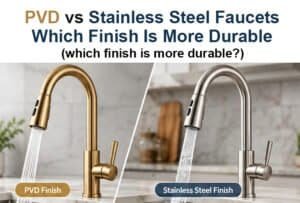
For example, PVD finishes are designed to provide a durable surface and are commonly used for premium decorative faucet finishes.
If you are comparing finishes, you can internally link this section to:
PVD vs Stainless Steel Faucets: Which Finish Is More Durable?
You can also link to:
Matte Black vs Stainless Steel Faucets: Which Finish Is Better?
This creates a strong internal SEO connection between your faucet durability articles.
Are 304 Stainless Steel Faucets More Durable?
304 stainless steel faucets are an excellent choice for buyers who prioritize corrosion resistance and long-term durability.
A quality 304 stainless steel faucet can be particularly suitable for:
- Kitchen applications
- High-use environments
- Modern homes
- Commercial projects
- Areas where corrosion resistance matters
However, material alone doesn’t determine the entire lifespan.
A faucet also depends on:
- Cartridge quality
- Seals
- Hoses
- Spray head
- Manufacturing precision
- Installation
- Water conditions
So when purchasing a 304 stainless steel kitchen faucet, don’t look only at the material specification.
Look at the entire construction.
How to Choose a Long-Lasting Kitchen Faucet?
If your goal is to buy a faucet that will last for many years, consider these eight factors.
1. Choose a Durable Body Material
Look for genuine 304 stainless steel or quality brass construction when appropriate for your application.
2. Check the Cartridge
A quality ceramic cartridge is an important component of a durable faucet.
3. Consider Your Water Quality
Hard water can increase maintenance requirements.
4. Look for Replaceable Parts
A faucet is easier to maintain when cartridges, aerators, hoses and spray heads can be replaced.
5. Check the Finish
If appearance matters, consider durable finishes such as quality PVD or brushed finishes.
6. Consider Usage
A heavily used kitchen needs a faucet designed for frequent operation.
7. Check the Warranty
A clear warranty can provide useful information about the manufacturer’s confidence in its product.
8. Choose a Reliable Supplier
For homeowners, choose an established manufacturer or brand.
For wholesalers, importers and project buyers, also evaluate:
- Factory experience
- Quality control
- Product testing
- Certifications
- Spare parts
- OEM/ODM capability
- Production capacity
- Delivery reliability
Kitchen Faucet Lifespan: Final Verdict
So, how long do kitchen faucets last?
A quality kitchen faucet can often last 10–20 years, while some well-built products can provide service toward or beyond the upper end of that range. Lower-cost products may require replacement sooner, particularly when exposed to heavy use, hard water or poor maintenance.
But the age of the faucet isn’t the only thing that matters.
A 12-year-old faucet with a solid body and a replaceable cartridge may still be worth repairing.
A 6-year-old faucet with severe corrosion, repeated leaks and unavailable replacement parts may be a better candidate for replacement.
The most important factors are:
Material + cartridge + water quality + usage + maintenance + installation quality.
If you’re buying a new faucet, prioritize durable materials, reliable internal components, replaceable parts and a finish that suits your environment.
For many modern kitchens, a 304 stainless steel kitchen faucet with a quality ceramic cartridge can be an excellent long-term choice.
And if you want additional functionality, options such as pull-down, touchless and water filter faucets can combine durability with modern kitchen convenience.
Frequently Asked Questions
A quality residential kitchen faucet can often last around 10–20 years, although actual lifespan varies based on material, usage, water quality, maintenance and construction quality.
There is no fixed replacement schedule. Replace a faucet when its body is damaged, corrosion is severe, repairs become frequent, replacement parts are unavailable, or you want improved functionality.
Many modern faucet cartridges can last approximately 5–15 years, depending on water quality, usage and component quality.
Quality stainless steel faucets can offer excellent long-term durability and corrosion resistance. However, the cartridge, seals, hose and other components also affect the faucet's overall service life.
Hard water can increase mineral buildup and contribute to problems with aerators, cartridges and spray heads. Regular cleaning and maintenance can help reduce its impact.
If the faucet body is in good condition and the problem is a cartridge, O-ring, aerator or hose, repair is often sensible. If the body is cracked, severely corroded or repeatedly failing, replacement is usually more practical.

 English
 Arabic
 Dutch
Dutch French
 German
 Greek
Greek Irish
Irish Italian
 Latin
Latin Polish
 Portuguese
 Russian
 Slovak
 Spanish
 Swedish
 Turkish