
Water-Saving Kitchen Faucets: Benefits, Features and Buying Tips
Introduction
Water conservation has become an important consideration for modern homeowners, builders, and property developers. From reducing household utility bills to protecting valuable water resources, small changes in daily water usage can make a meaningful difference.
One effective way to improve water efficiency in the kitchen is to install a water-saving kitchen faucet.
Traditional kitchen faucets can consume more water than necessary, especially when they are used frequently for washing dishes, rinsing vegetables, filling pots, and cleaning countertops. Modern water-efficient kitchen faucets are designed to control water flow while maintaining a comfortable and practical user experience.
With technologies such as low-flow aerators, flow restrictors, optimized spray patterns, and improved faucet designs, homeowners can reduce unnecessary water consumption without giving up everyday convenience.
But what exactly makes a kitchen faucet water-efficient? How much water can a low-flow faucet save? And what features should you consider before buying one?
In this guide, we will explain the benefits, technologies, flow rates, and important buying tips to help you choose the best water-saving kitchen faucet for your needs.
1. What Is a Water-Saving Kitchen Faucet?
A water-saving kitchen faucet is designed to reduce unnecessary water consumption by controlling the amount of water flowing through the spout.
Unlike some traditional faucets that allow relatively high water flow, a water-efficient faucet uses specially designed internal components to regulate water output.
These components may include:
Water-saving aerators
Flow restrictors
Pressure-compensating flow regulators
Optimized spray heads
Single-handle temperature and flow controls
Pause or temporary shut-off functions
The main purpose is to provide sufficient water for everyday kitchen activities while reducing excessive flow.
For example, a conventional kitchen faucet may have a maximum flow rate of 2.2 gallons per minute (GPM), while some water-efficient models are designed to operate at 1.5 or 1.8 GPM.
The actual water savings depend on how frequently the faucet is used, the water pressure, and the user’s habits.
A well-designed low-flow kitchen faucet should balance water efficiency with practical performance.
2. Benefits of Water-Saving Kitchen Faucets
Choosing a water-efficient kitchen faucet offers several advantages for homeowners, commercial properties, and environmentally conscious buyers.
2.1 Reduce Water Consumption
The most obvious advantage is reduced water usage.
Kitchen faucets are used many times throughout the day. Even a small reduction in water flow can add up over weeks and months.
For example, consider two kitchen faucets:
Faucet Flow Rate | Water Used in 1 Minute |
|---|---|
2.2 GPM | 2.2 gallons |
1.8 GPM | 1.8 gallons |
1.5 GPM | 1.5 gallons |
Compared with a 2.2 GPM faucet, a 1.8 GPM model uses approximately 18% less water per minute when operated under comparable conditions.
A 1.5 GPM model uses approximately 32% less water per minute.
These figures describe flow-rate differences, not guaranteed household savings. Actual savings depend on operating time and usage patterns.
2.2 Lower Water and Energy Bills
Water-saving kitchen faucets can help reduce household water expenses.
There is also a potential energy-saving benefit.
When people use hot water for washing dishes or cleaning, the water heater must consume energy to heat the water. Reducing unnecessary hot-water flow can therefore reduce both water and water-heating energy consumption.
This makes efficient kitchen faucets a practical option for households looking to improve overall resource efficiency.
2.3 Environmentally Friendly Choice
Water is an important natural resource, and reducing unnecessary consumption helps support more sustainable living.
Installing water-efficient plumbing fixtures is one practical step homeowners can take to reduce their environmental impact.
For builders, developers, and hotel operators, selecting efficient faucets across multiple kitchens can also contribute to broader water-management goals.
2.4 Maintain Everyday Kitchen Convenience
A common concern about low-flow faucets is that they may produce weak water streams.
However, modern faucet aerators and flow-regulating technologies can help create a comfortable, controlled stream.
The goal is not simply to reduce water volume. It is to make better use of the water being delivered.
A well-designed faucet can provide useful flow for rinsing vegetables, washing dishes, and filling containers while avoiding unnecessary splashing.
2.5 Support Modern Kitchen Design
Water-saving technology can be integrated into many different faucet styles.
Popular options include:
Modern pull-down kitchen faucets
Pull-out kitchen faucets
Single-handle kitchen faucets
Touchless kitchen faucets
Stainless steel kitchen faucets
Commercial-style kitchen faucets
Homeowners do not necessarily need to sacrifice appearance or functionality to choose a water-efficient model.
3. How Do Water-Saving Kitchen Faucets Work?
Several technologies help control water consumption in modern kitchen faucets.
Understanding these features can help you select a suitable product.
3.1 Water-Saving Faucet Aerator
A kitchen faucet aerator is one of the most common water-saving components.
It is usually installed at the end of the faucet spout and mixes air into the water stream.
An aerator can:
Help regulate water flow
Reduce unnecessary water consumption
Create a softer, more controlled stream
Reduce splashing
Improve the perceived fullness of the water stream
Some aerators also contain flow-control components that limit the maximum water output.
However, an aerator does not automatically guarantee a specific flow rate. The actual result depends on its design and the water pressure.
For homeowners with existing faucets, replacing an inefficient or damaged aerator may be a simple way to improve water efficiency without replacing the entire faucet.
3.2 Flow Restrictors
A flow restrictor is a small component designed to limit the amount of water passing through a faucet.
It may be installed inside the aerator, spray head, or faucet connection, depending on the product design.
Flow restrictors help maintain a controlled maximum flow rate.
When choosing a faucet with a flow restrictor, buyers should check whether the product provides sufficient flow for normal kitchen tasks.
A flow rate that is too low may make filling large pots or rinsing dishes inconvenient.
3.3 Pressure-Compensating Flow Regulators
Water pressure can vary between buildings and locations.
Without proper regulation, a faucet may deliver different amounts of water under different pressure conditions.
Pressure-compensating regulators are designed to help maintain a more consistent flow rate as inlet pressure changes within their operating range.
This can improve water efficiency and provide a more predictable user experience.
3.4 Spray Mode and Pause Functions
Some modern kitchen faucets offer multiple spray modes, including:
Stream mode for filling pots and containers
Spray mode for rinsing dishes and vegetables
Pause mode for temporarily stopping water flow
A pause function is particularly useful when moving between kitchen tasks.
For example, users can stop water temporarily while scrubbing dishes rather than allowing water to run continuously.
The effectiveness of this feature depends on the faucet’s design and how consistently users operate it.
4. What Is the Best Flow Rate for a Water-Saving Kitchen Faucet?
Flow rate is one of the most important specifications to check when buying a low-flow kitchen faucet.
It is generally measured in gallons per minute (GPM) or liters per minute (L/min).
For reference:
Flow Rate | Equivalent |
|---|---|
1.5 GPM | 5.7 L/min |
1.8 GPM | 6.8 L/min |
2.0 GPM | 7.6 L/min |
2.2 GPM | 8.3 L/min |
In the United States, the federal maximum flow rate for kitchen faucets is generally 2.2 GPM at 60 psi. Some local jurisdictions have stricter requirements.
The EPA’s kitchen faucet technical guidance identifies models in the 1.5–1.8 GPM range as options for greater water efficiency. However, EPA does not currently have a separate WaterSense specification for kitchen faucets.
Which Flow Rate Should You Choose?
1.5 GPM: Maximum water-saving focus
Suitable for users who prioritize reducing water consumption and whose kitchen tasks can be handled comfortably at this flow rate.
1.8 GPM: Balanced efficiency and performance
A practical option for many residential kitchens, combining reduced flow with everyday usability.
2.2 GPM: Higher flow needs
May be preferable for users who frequently fill large pots or require stronger flow, subject to local requirements.
The best choice depends on water pressure, sink size, household habits, and the intended application.
5. Important Features to Look for When Buying a Water-Saving Kitchen Faucet
Not every faucet marketed as water-saving provides the same level of performance.
Before purchasing, consider these important features.
5.1 High-Quality Aerator
The aerator plays an important role in controlling the water stream.
Look for an aerator that provides a consistent flow, reduces splashing, and can be removed for cleaning or replacement.
5.2 Durable Faucet Material
The faucet body material affects durability, corrosion resistance, and maintenance.
Common choices include:
304 stainless steel
Brass
Zinc alloy
304 stainless steel is popular for its corrosion resistance and practical maintenance characteristics.
Brass is also widely used in faucet manufacturing because of its strength and machinability.
The best material depends on the product specification, manufacturing quality, and application.
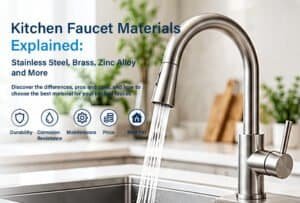
For a more detailed comparison, read our guide to Kitchen Faucet Materials Explained: Stainless Steel, Brass, Zinc Alloy and More.
5.3 Ceramic Disc Cartridge
A ceramic disc cartridge controls water flow and temperature.
A good-quality cartridge helps provide smooth handle operation and reliable sealing.
Although a ceramic cartridge is not itself a water-saving device, it can help prevent leaks and unnecessary water waste caused by dripping.
5.4 Single-Handle Design
Single-handle kitchen faucets allow users to adjust water temperature and flow with one hand.
This makes operation convenient and can help users control water output more easily.
5.5 Pull-Down or Pull-Out Sprayer
Pull-down and pull-out faucets provide greater flexibility for kitchen cleaning.
Their spray heads can make it easier to rinse dishes, wash vegetables, and reach different areas of the sink.
Some models also include spray and pause functions that help users control water during different tasks.
Learn more about the differences in our article: Pull-Down vs Pull-Out Kitchen Faucets: Which One Is Better for Your Home?.
5.6 Touchless Technology
Touchless kitchen faucets use sensors to activate water flow without requiring users to touch the handle.
They can improve convenience when preparing food or handling dirty dishes.
However, touchless technology does not automatically guarantee water savings. Actual consumption depends on sensor settings, activation behavior, flow rate, and how long the water remains on.
Choose a touchless model based on its overall performance rather than assuming the sensor alone makes it water-efficient.
6. How to Choose the Best Water-Saving Kitchen Faucet
Choosing the right faucet requires more than checking its flow rate.
Here are six practical steps.
Step 1: Check the Rated Flow Rate
Look for the manufacturer’s rated GPM at a specified water pressure.
Do not compare flow rates without checking the test pressure, because pressure affects water output.
Step 2: Choose the Right Faucet Type
Consider whether you need a standard kitchen faucet, pull-down faucet, pull-out faucet, or touchless model.
Your sink size and daily habits should guide your decision.
Step 3: Check the Aerator and Flow Regulator
Confirm whether the faucet includes a water-saving aerator or flow regulator.
It is also helpful if these components can be cleaned or replaced.
Step 4: Select a Durable Material
Choose a faucet made with suitable materials and reliable internal components.
For example, 304 stainless steel and quality lead-compliant brass are common options for kitchen faucet manufacturing.
Step 5: Consider Installation Compatibility
Check the number of mounting holes, countertop thickness, water supply connections, and available installation space.
Step 6: Verify Product Standards and Local Requirements
Different countries and regions may have different plumbing standards and maximum flow-rate requirements.
For the U.S. market, check applicable federal, state, and local rules. For international projects, confirm the required product certifications and test reports before ordering.
7. Are Water-Saving Kitchen Faucets Worth It?
For many households, water-saving kitchen faucets are a worthwhile investment.
They can reduce unnecessary water consumption, help lower water-heating costs, and support more sustainable household practices.
However, the benefits depend on several factors:
The original faucet’s flow rate
The new faucet’s rated flow rate
Daily usage time
Water pressure
The number of people in the household
The amount of hot water used
For example, replacing a 2.2 GPM faucet with a 1.8 GPM model reduces the maximum flow by approximately 18%.
If the faucet is used for long periods every day, the difference can become meaningful over time.
For homeowners who do not want to replace an entire faucet, installing a compatible water-saving aerator may also be an economical option.
The key is to choose a product that balances efficiency, convenience, and durability.
8. Water-Saving Kitchen Faucets for Wholesale Buyers and Importers
Water efficiency is also an important consideration for faucet distributors, importers, wholesalers, and construction project buyers.
As more markets focus on sustainable building products, demand for water-efficient plumbing fixtures creates opportunities for manufacturers and suppliers.
When sourcing water-saving kitchen faucets, wholesale buyers should evaluate:
1. Flow Rate Options
Ask manufacturers whether they can provide 1.5 GPM, 1.8 GPM, or other flow-rate configurations.
2. Aerator Customization
Different markets may require different aerator specifications. Confirm available flow rates and compatibility.
3. Material and Manufacturing Quality
Check the faucet body material, cartridge quality, surface treatment, and manufacturing process.
4. Product Testing and Certifications
Request relevant test reports and verify that the products meet the standards required in the destination market.
5. OEM and ODM Services
For private-label brands, customized packaging, logo printing, product finishes, and technical specifications can help create a differentiated product range.
Working with an experienced faucet manufacturer can make it easier to develop products that meet different market requirements.
FaucetU provides kitchen and bathroom faucet manufacturing, customization, and OEM/ODM support for international partners.
9. Frequently Asked Questions About Water-Saving Kitchen Faucets
Some water-efficient kitchen faucets are available with flow rates of 1.5–1.8 GPM. The ideal rate depends on water pressure, local regulations, and everyday kitchen requirements.
A low-flow faucet reduces the amount of water delivered per minute, but this does not necessarily mean the water pressure is weak.
A well-designed aerator can create a comfortable stream while controlling water consumption.
Yes. A compatible water-saving aerator can reduce the flow rate of an existing faucet. The actual savings depend on the original flow rate and the replacement aerator's specifications.
Not automatically. Touchless technology improves convenience, but water savings depend on sensor operation, flow rate, and user behavior.
No. EPA's WaterSense labeling criteria currently cover private bathroom sink faucets and certain other specified products, but not ordinary kitchen faucets. Buyers should check the applicable kitchen faucet standards and local requirements instead.
They can be suitable for some commercial applications, but the required flow rate depends on the work being performed. Kitchens that frequently fill large containers or require high-volume rinsing may need different specifications.
Conclusion
Water-saving kitchen faucets are a practical choice for homeowners, builders, and commercial property developers who want to reduce unnecessary water consumption without sacrificing everyday convenience.
With technologies such as aerators, flow restrictors, pressure-compensating regulators, and spray-control functions, modern kitchen faucets can provide a more efficient water experience.
When choosing a water-efficient kitchen faucet, pay attention to its rated flow rate, material, cartridge, aerator quality, spray functions, and applicable standards.
Whether you are upgrading a home kitchen or sourcing products for wholesale distribution, selecting the right water-saving faucet can provide a good balance of performance, durability, and resource efficiency.


 English
 Arabic
 Dutch
 French
 German
 Greek
 Irish
 Italian
 Latin
 Polish
 Portuguese
 Russian
 Slovak
 Spanish
 Swedish
 Turkish